


For property owners – from Long Island to Brooklyn to Buffalo – flood barriers in New York are no longer optional infrastructure. The state has lived through some of the most consequential flood events in American history:
- Hurricane Sandy redrew the map of New York City’s flood vulnerability in 2012
- Hurricane Ida turned basement apartments into death traps in 2021
- The July 2023 Hudson Valley flash floods washed out roads and bridges across the region
- In July 2025, flash flooding paralyzed Manhattan and Queens within hours of the first storm cells crossing the boroughs.
- Most recently, flash flooding in May 2026 caused catastrophic damages in Brooklyn and Queens
Here is a closer look at the flood risks facing New York today and how the right flood barriers can help residential, commercial, and municipal properties stay open and stay dry.
The State of Flooding in New York
New York’s flood risk is not concentrated in any single region. The state faces several distinct flood threats, often hitting different communities in the same year:
- Coastal storm surge – Hurricane Sandy remains the defining event for New York City and Long Island flood planning. The 2012 superstorm sent a record tidal surge of roughly 13 to 14 feet into Lower Manhattan, flooded subway tunnels and the Brooklyn-Battery Tunnel, knocked out power to roughly 8 million customers across the region, and caused approximately $65 billion in damages across 24 states. New York City alone recorded around 52 fatalities, and Nassau and Suffolk Counties have absorbed the largest share of National Flood Insurance Program payments in the state since records began.
- Extreme rainfall and inland flooding – Hurricane Ida in September 2021 made it brutally clear that you do not need a storm surge to flood New York. Rain fell faster than New York City’s stormwater system could drain it, producing unprecedented inland flooding and tragic loss of life in basement apartments. Two years later, the September 2023 New York floods dropped nearly 10 inches of rain on parts of Brooklyn and the surrounding metro area, with Governor Hochul declaring a state of emergency across the five boroughs, parts of the Hudson Valley, and Long Island.
- Flash flooding upstate and in the Hudson Valley – The July 2023 Northeastern floods caused more than $2 billion in damage across New York and Vermont, with Putnam Valley recording over 10 inches of rainfall in a single event. In July 2025, another extreme rainfall event paralyzed Manhattan subway service, stranded passengers as water poured into stations, and grounded flights across LaGuardia, JFK, and Newark.
- Tidal flooding and sea level rise – Even without a named storm, New York City has seen a significant increase in high-tide flood days from 2000 to 2021. Tidal flooding now happens in clear weather, and the trend is accelerating.
- Increasing frequency – From 1980 through 2024, New York absorbed 95 separate billion-dollar weather and climate disasters. The annual average across that period is roughly 2.1 events. The annual average for 2020 through 2024 is 6.2. State Comptroller Thomas DiNapoli’s 2025 report put it plainly: in the 1980s, New York averaged 82 days between highly damaging events. Between 2020 and 2024, the gap shrank to just 16 days.
- Off-floodplain flooding – Only about 3 percent of New York buildings are covered by National Flood Insurance Program policies, because NFIP coverage is generally required only for properties in designated high-risk flood zones. Yet flash flooding and extreme rainfall regularly damage properties well outside those zones. New York property owners outside the floodplain are not safe by default.
In short, no part of New York is immune to the risk of flooding
What Flood Barriers in New York Should Offer
Flood barriers are not a single product. The most effective flood protection programs in New York combine assessment, engineering, installation, and ongoing support into a complete system. Here is what to look for:
- On-site flood risk assessment – Every property has unique vulnerabilities. A professional assessment walks your building and identifies every point where water can enter – doors, garages, loading docks, elevators, electrical equipment, sub-grade entrances, and underground spaces.
- Custom-engineered flood barriers – Off-the-shelf products rarely fit the openings, opening sizes, and architectural details of a real New York property, especially older buildings, landmark structures, and mixed-use properties. Custom flood panels, flood gates, and flood doors deliver far better protection.
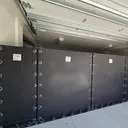
- Multiple product options – A complete provider offers deployable flood panels, permanent flood doors, swing-hinged flood gates, passive automatic floodgates, water-filled barriers, foldable flood barriers, and specialty equipment protection so the right tool can be matched to each vulnerability.
- Professional installation – Proper anchoring, sealing, and integration with existing architecture is the difference between a flood barrier that holds and one that fails.
- Staff training – Your team should know how to deploy your flood barriers quickly and correctly, ideally with documented procedures and periodic drills before storm season.
- Maintenance and inspection – Flood barriers need regular inspection to ensure seals, gaskets, and hardware remain in top condition between events.
Why New York Property Owners Choose Flood Risk America
FRA provides flood protection across the country, with deep experience in both coastal storm surge and inland flash flood environments, exactly the dual threat profile New York faces. Our patented Flood Panel system has protected properties through multiple Category 3, 4, and 5 hurricanes, and our portfolio of flood gates, flood doors, foldable barriers, and specialty products gives New York property owners every tool they need to defend their buildings.
Just as importantly, we treat flood protection as a service, not a transaction. From the first assessment through years of maintenance, our team partners with property owners to make sure their flood defenses are ready when they are needed most. Every product is engineered and manufactured in the United States, tested to FEMA standards, and built to last through decades of Northeast weather.
Looking for the Best Flood Barriers in New York?
With New York averaging more than six billion-dollar weather disasters per year between 2020 and 2024, the question is no longer whether the next flood event will come – it is whether your property will be ready when it does.
Investing in professional flood barriers before the next event is one of the most reliable ways to protect everything you have worked to build. To learn more about flood barriers in New York or to schedule an on-site assessment for your property, contact the Flood Risk America team today.