

Most flood protection problems start with a tape measure. A doorway that’s an inch wider than a standard panel. A loading dock with a slight slope. A historic facade where you can’t drill into the masonry. The off-the-shelf flood barrier panels you see in catalogs are designed for the average opening, and average openings are rare.
That’s why custom flood barrier panels exist, and that’s where Flood Risk America has built our reputation.
What Makes a Flood Barrier Panel “Custom”
A custom flood barrier panel is engineered, fabricated, and finished to match the exact dimensions, substrate, and design flood elevation (DFE) of your opening. That means we:
- Measure the opening on-site or work from architectural drawings
- Calculate the hydrostatic load it needs to handle
- Choose a material and gasket system that seals against your specific surface
- Custom fabricate the panel to fit
The result is a barrier that drops in cleanly, seals tightly, and meets the certification standards your insurance carrier or local code official will ask about. By contrast, a stock panel forces you to adapt the building to the product. You add shims. You bolt on filler strips. You accept gaps and hope the leakage stays manageable.
For a residential garage in a moderate flood zone, that compromise might be acceptable. For a commercial property, a critical facility, or any building in a Special Flood Hazard Area where FEMA dry floodproofing certification matters, it usually isn’t.
Where Custom Barrier Panels Earn Their Keep
Doorways are the most common application, but they’re far from the only one.
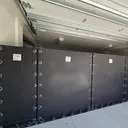
Loading docks and parking garages present some of the toughest challenges in flood protection because the openings are wide, the floor surfaces are often uneven, and the panels need to deploy fast when a storm is bearing down. A custom panel system can span an entire loading dock or parking garage opening with a sealing system designed for the specific concrete profile underfoot.
Storefronts and retail entrances are another high-value application. A retail tenant typically can’t afford the kind of permanent flood gate that works on industrial buildings. They need a panel system that’s invisible when not in use, deployable by store staff in minutes, and finished to match the storefront aesthetic. Custom fabrication makes that possible.
Then there are the unusual cases:
- Curved facades
- Stairwells leading to below-grade equipment rooms
- Window wells protecting basement-level apartments
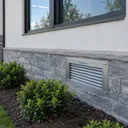
- Historic buildings where any drilling is unfavorable
We’ve fabricated panels for all of these, and the common thread is that no catalog product would have worked.
The Engineering Behind a Tight Seal
A flood barrier panel is only as good as its seal. The aluminum or composite face of the panel handles the structural load, but it’s the gasket system and the connection to the surrounding wall and floor that determine whether you stay dry. This is one of the areas where custom fabrication matters most.
Our panels use compression-sealed gaskets so that when you tighten the tool-free Easy-Turn Knobs, the gasket compresses uniformly across the entire perimeter, creating a seal that holds against hydrostatic pressure from rising floodwater. On the structural side, every custom panel we fabricate is engineered to handle taller installations or wider openings, with added intermediate support when needed.
Certifications and Compliance
FRA Flood Panels are designed in accordance with established industry standards and regulatory frameworks used across commercial and municipal projects. This includes alignment with:
- ASCE 24 (Flood Resistant Design and Construction)
- ASCE 7 (Minimum Design Loads for Buildings and Other Structures), ensuring the system integrates with overall building design criteria and load paths.
In addition, performance criteria follow:
- FEMA Technical Bulletin 3-93 (Non-Residential Floodproofing)
- U.S. Army Corps of Engineers Flood Proofing Regulations (EP 1165-2-314), which define requirements for dry floodproofing systems in non-residential applications.
Verified Performance Criteria
Our custom flood barrier panels are engineered to meet the loading and impact requirements outlined in FEMA TB 3-93, including:
- Hydrostatic loads – resistance to lateral forces from standing water based on design flood elevations
- Hydrodynamic loads – resistance to moving water forces, with design velocities up to 8 ft/sec
- Debris impact loads – capacity to withstand impact from a 1,000 lb object traveling at specified velocities
All imposed loads are transferred to the primary structure, consistent with ASCE load path requirements.
USACE Classification and Seepage Criteria
FRA Flood Panels are classified as Type 2 Closures under U.S. Army Corps of Engineers guidelines. As defined by USACE, this classification allows for controlled seepage under flood conditions.
Seepage performance is consistent with ANSI/FM 2510, with allowable leakage rates not exceeding 0.08 gallons per hour per linear foot of protected opening.
Documentation for Design and Permitting
To support specification, permitting, and construction, FRA provides:
- Manufacturer data sheets and installation requirements
- Detailed shop drawings, including anchorage, sections, and connection details
- Engineering calculations (sealed when required by the AHJ) verifying performance under design loads
- Operation and maintenance documentation for lifecycle performance
What the Process Looks Like
A typical custom flood barrier panel project starts with a site visit or a detailed review of your drawings. We document every opening, identify the substrate conditions, and confirm the design flood elevation you need to protect against. From there, our engineering team produces shop drawings for your review. Once approved, fabrication runs four to six weeks for most projects, with installation scheduled around your operations.
After installation, we walk through deployment training with your team, or offer 24/7 flood panel deployment services ahead of the storm. Most clients run a full deployment drill within the first month, and we recommend an annual inspection and refresher. The panels themselves are designed for decades of service with minimal maintenance, including gasket replacement every several years, depending on use, and routine inspection of fasteners and finishes.
Are Custom Flood Barrier Panels Right for Your Project?
If your property’s entryways are truly standard, your flood risk is moderate, and your budget is tight, a stock system might get you there. But “might” is a hard word to sit with when the stakes are high.
For commercial facilities, critical operations, or your valuable home where a single flood event could cost more than the entire project, custom flood barrier panels aren’t a premium – they’re the only version of protection that actually fits.
Flood Risk America has designed and installed custom flood barrier panels across the globe, from coastal Florida properties to commercial facilities in Australia. If you’d like to talk through your project, reach out to our team for a no-obligation site assessment.