

Tropical Storm Arthur made landfall along the Texas-Louisiana coast this week – the first named storm of the 2026 Atlantic hurricane season, and one that forecasters at the National Hurricane Center are describing as a life-threatening flood event with significant rainfall and storm surge.
For commercial property owners in New Orleans, Baton Rouge, Lake Charles, Lafayette, and communities across the Louisiana coast and interior, Arthur is a reminder of something this state has learned through hard experience: New Orleans does not have the luxury of treating floods as rare events.
Flooding is the defining natural hazard of this state, and the question is never whether the next event will come – it is whether your property has the best flood protection in New Orleans with high-quality barriers and the right plan.
What Flood Protection in New Orleans Should Offer
New Orlean’s flood environment is among the most complex in the country. Commercial and institutional properties here face storm surge from Gulf hurricane systems, catastrophic rainfall from inland events that produce no warning period, river flooding from an extensive network of bayous and rivers, and the ongoing reality of a coastline that provides less natural protection every year. For both commercial and residential properties, effective flood protection in New Orleans needs to address all of these scenarios.
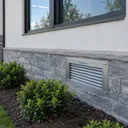
- On-site flood risk assessment Every New Orleans property has a specific vulnerability profile that reflects its elevation, proximity to waterways, surrounding drainage infrastructure, and building configuration. A professional assessment identifies every point where water can enter: doors, loading docks, garage openings, elevator pits, electrical rooms, and below-grade spaces.
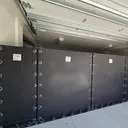
- Custom-engineered flood barriers – Custom flood panels, flood gates, and permanent flood doors built to a property’s exact dimensions outperform off-the-shelf alternatives in every scenario, but particularly in storm surge conditions where water pressure on barrier assemblies, seals, and anchor points is significant.
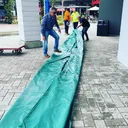
- Full product portfolio – Effective flood protection in New Orleans’ mixed flood threat environment requires deployable flood panels for doorways and openings, permanent flood doors for high-frequency exposure locations, passive automatic floodgates that self-activate when water arrives, swing-hinged flood gates for large openings, water-filled barriers for perimeter protection, foldable flood barrier systems for rapid deployment, and specialty protection for elevator pits, electrical equipment, and underground spaces.
- No-warning-period readiness – The 2016 Great Flood demonstrated that New Orlean’s most damaging flood events can develop and intensify faster than property owners expect. Flood barrier systems need to be designed for rapid deployment with minimal setup time, and staff need documented procedures and training to deploy correctly under time pressure.
- Professional installation – Proper anchoring into building structure, precision sealing at every joint and threshold, and integration with existing architecture are what separate flood barrier systems that hold under pressure from those that fail.
- Ongoing maintenance – New Orlean’s humidity, salt air in coastal areas, and storm season demands make regular inspection and maintenance of seals, gaskets, hardware, and anchor systems essential to sustained performance.
The State of Flooding in New Orleans
No state in the continental United States has absorbed more flood damage than New Orleans. Low elevation, a vast river drainage system, a subsiding coastline, and direct Gulf exposure have produced a flood record unlike anywhere else in the country.
- Hurricane Katrina (2005) – The costliest tropical cyclone in U.S. history inundated roughly 80 percent of New Orleans through dozens of levee failures, displaced more than one million people, and triggered more than $120 billion in federal Gulf Coast recovery spending.
- The Great Flood of 2016 – A nameless slow-moving storm dropped 7.1 trillion gallons of water on southern New Orleans in four days – three times the volume Katrina deposited. Rainfall exceeded 20 inches across multiple parishes, ten rivers hit record flood stages, and an estimated 146,000 homes across 56 parishes were damaged. Because it wasn’t a named storm, most affected property owners had no flood insurance.
- Hurricane Ida (2021) – Ida made landfall as a Category 4 storm with 150 mph winds – the strongest to hit New Orleans outside of Katrina – generating catastrophic wind damage and storm surge across southeast Louisiana, including communities that had invested heavily in post-Katrina flood infrastructure.
- Eroding coastline – New Orleans has lost more than 2,000 square miles of coastal land since the 1930s. The wetlands and barrier islands that once absorbed storm surge before it reached inland properties are disappearing, and surge now arrives with greater intensity as a result.
- Billion-dollar disaster frequency – NOAA recorded 106 billion-dollar weather disasters affecting New Orleans between 1980 and 2024. The five-year average from 2020 to 2024 is 6.8 events per year – nearly three times the long-term average.
- Off-floodplain flooding – The 2016 flood inundated parishes and properties that had never flooded during past hurricanes. New Orlean’s flood risk does not stop at FEMA flood zone boundaries.
Why New Orleans Property Owners Choose Flood Risk America
Flood Risk America brings extensive experience protecting commercial, institutional, and municipal properties in the Gulf Coast environment. Our patented Flood Panel system has been tested through multiple Category 3, 4, and 5 hurricane events – the conditions that define New Orlean’s most severe flood scenarios. Our full product portfolio gives New Orleans property owners every tool they need to defend against both storm surge and the kind of rapid inland flooding that produced the Great Flood of 2016. It’s the type of flood protection in New Orleans that can prevent costly damage and devastating losses.
Every FRA product is engineered and manufactured in the United States, tested to FEMA, NFIP, FM Approval, and U.S. Army Corps of Engineers standards, and designed to perform reliably through decades of Gulf Coast conditions. We treat flood protection in New Orleans as a long-term partnership: from first assessment through installation, staff training, and ongoing maintenance, our team is with you before, during, and after every storm season.
Looking for the Best Flood Protection in New Orleans?
Tropical Storm Arthur moved through the region this. But Arthur is not the story – it is one chapter in a flood record that has made New Orleans the most flood-impacted state in the country. The time to seek flood protection in New Orleans, including installing professional flood barriers, is not during a storm warning. It is now.
To schedule an on-site flood risk assessment for your property, contact the Flood Risk America team today.