


“What’s are the best commercial flood barriers?” is one of the most common questions our team gets, and it’s also one of the hardest to answer in a sentence. The honest answer is that the best system for any given property depends on the building, the flood risk, the operational constraints, and the budget.
What we do at Flood Risk America is work with facility managers, property owners, architects, and engineers to walk through the categories of commercial flood barriers that consistently perform well, what each one is good at, and how to think about choosing among them.
What “Commercial” Means in Flood Protection
Before getting into specific products, it’s worth being clear about what makes a flood barrier a commercial flood barrier. The difference isn’t just size. A commercial-grade system is engineered to meet certification standards typical commercial projects require, including ANSI/FM 2510 testing, finite element analysis documentation, and FEMA Technical Bulletin 3 dry floodproofing requirements where applicable.
It’s designed for repeated deployments over decades. And it’s specified with the documentation an insurance underwriter, code official, or engineer of record will need to sign off. Plenty of products marketed for residential use will physically hold back water. Few of them carry the certifications, engineering, and durability required for a commercial setting.
When a flood event affects a commercial property, the dollar exposure (building damage, business interruption, inventory loss, equipment replacement) is typically large enough that under-spec hardware creates more risk than it prevents.
Category 1: Deployable Commercial Flood Barriers
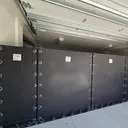
Deployable flood barriers are the most flexible category and the most widely specified for commercial flood barriers where openings need to remain unobstructed during normal operations.
Where deployable systems shine is in retail, hospitality, office buildings, and any property with public-facing openings. Properly engineered, they hold back several feet of floodwater against hydrostatic pressure.
The trade-off is that they require human intervention. Someone has to deploy them when a storm is forecast, which means staff training, deployment drills, and a written response plan. For properties with reliable on-site staff and adequate forecast warning time, this is a manageable trade-off. For unattended sites or rapid-onset flood scenarios, a deployable-only strategy may not be enough.
Category 2: Passive Flood Barriers
Passive flood barriers engage automatically when floodwater rises, with no human intervention required. The category includes automatic floor-mounted barriers that rotate up out of a recessed channel, also known as a flood gate.
The biggest advantage is reliability. Passive commercial flood barriers don’t depend on staff being on-site, on the forecast being right, or on the deployment plan being executed perfectly. It just works when water arrives. For critical infrastructure, including data centers, hospitals, utility substations, transportation hubs, passive protection is often specified as the primary line of defense.
The trade-offs are cost and physical footprint. Passive systems are typically more expensive per opening than deployable equivalents, and they require more substantial structural integration with the building. For high-value critical openings, the cost is justified. For every opening on a sprawling commercial property, it usually isn’t.
Category 3: Swing-Hinged Gates
When flood risk is severe and site access must be maintained, a swing-hinged flood gate is often the right permanent solution. This category includes engineered gate systems mounted on fixed hinge posts, designed to protect wide openings like driveways, vehicle access points, and perimeter gaps where a solid wall isn’t practical.
Swing-hinged gates are most often deployed at site perimeters, facility entrances, and around high-value assets like generators and electrical substations, anywhere you need both flood protection and the ability to open and close the barrier as needed.
The advantages are significant:
- Permanent installation with no barrier to deploy from scratch
- Fast activation by a single operator
- A long service life with minimal maintenance.
The tradeoffs are real too: gate systems require a clear swing path, fixed anchor points, and upfront site preparation, and like any permanent structure, installation in a floodplain may require regulatory review.
Most systems for commercial flood barriers pair swing-hinged gates with deployable or passive barriers rather than relying on gates alone. The gate handles high-traffic or wide openings, while other barrier types protect the remaining entry points.
Category 4: Permanent Flood Doors
A permanent flood door is exactly what it sounds like: a door engineered to resist hydrostatic pressure and seal against floodwater while still functioning as a normal door during dry conditions.
Permanent flood doors are a strong option when looking for the right commercial flood barriers that need to function as doors year-round and as flood protection when a storm hits. Pedestrian entries, emergency exits, mechanical room access points, and back-of-house service doors are common applications. A modern engineered flood door looks and operates like an ordinary door but seals against substantial flood depths when closed and locked.
Category 5: Water-Filled and Fabric-Based Flood Barrier Systems
When you need to protect a long perimeter fast, water-filled and fabric-based flood barrier systems are built for the job. Flood Risk America offers two distinct products in this category for commercial flood barriers: the Water-Filled Flood Barrier and the Aqua-Fabric Flood Barrier.
- Water-Filled Flood Barriers are self-weighted, rapidly deployable tubes that use the weight of water to hold their position against incoming floodwater. They’re well-suited for emergency perimeter protection, temporary access road protection, and situations where barriers need to be repositioned between events.
- The Aqua-Fabric Flood Barrier takes a different approach: a reinforced textile system designed for continuous wall protection along a vulnerable elevation. It excels at large-perimeter scenarios,surrounding a building footprint, protecting a yard or staging area, or creating an extended barrier line where rigid systems would be impractical or cost-prohibitive.
Together, these systems cover the scenarios where speed, portability, and scalability are priorities. They’re particularly valuable for emergency response operations, contractor applications, and facilities where the protection footprint shifts from event to event.
Category 6: The Details That Don’t Get Ignored
A complete flood protection program isn’t just about doors, gates, and perimeter barriers. Floodwater finds the gaps that are often overlooked, including the electrical outlet at knee height, the generator that can’t be moved, the ATM in the lobby. Flood Risk America addresses those overlooked vulnerabilities too, with two purpose-built products that protect what other commercial flood barriers leave exposed.
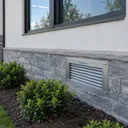
- The Electric Box Cover is designed to protect electrical panels and outlets from water intrusion. Built from the same heavy-duty materials as FRA’s patented flood panels and featuring advanced CCN Seal Technology, it forms a watertight barrier around the electrical components that keep your building running. A flooded outlet can mean power loss, equipment damage, or a fire hazard – the Electric Box Cover eliminates that risk with a tool-less, quick-deploy design and a lifetime warranty.
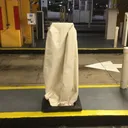
- The Flood Cover is a custom-fit, fabric-based solution for equipment that can’t be moved, including generators, ATMs, parking equipment, electrical panels, and other stationary assets that a standard barrier simply can’t reach. Made from durable UV-resistant polyester and polypropylene fabric, it’s rated to withstand winds up to 170 MPH and temperatures from -40°F to +200°F. Each cover is sized to your exact equipment dimensions and anchored using the same system as FRA’s flood panels, with a high-performance gasket that seals against uneven surfaces where generic covers fail.
How to Choose the Right Combination of Commercial Flood Barriers
The best solution for commercial flood barriers almost always use multiple categories together rather than a single system. A typical engineered solution might include passive flood doors on critical entries, deployable aluminum panels on loading docks and storefronts, a permanent berm around the most exposed elevation, and a flexible fabric system for emergency perimeter extension.
The decision process starts with a site assessment. Every opening, vulnerability, and elevation is assessed. Operational constraints are mapped, including who’s on site, how much warning will they have, what can be deployed in what time window, and if the property requires flood deployment services. Then the protection categories are layered against the openings and the operational picture, with the most critical getting the highest protection level.
What to Ask Any Commercial Flood Barriers Vendor
When evaluating commercial flood barriers, the conversation should go beyond product specs. Be sure to ask for:
- The actual ANSI/FM test reports for each product line, not just a claim that they meet the standard.
- FEA documentation on hydrostatic load capacity at the heights you need.
- FEMA Technical Bulletin 3 compliance documentation if dry floodproofing certification is part of your project.
- Case studies on similar buildings in similar flood environments.
- Post-installation support. Who provides deployment training? What happens when a gasket needs replacement five years out?
A flood protection system is a multi-decade commitment, and the vendor relationship matters as much as the hardware spec.
The Bottom Line
There is no single “best commercial flood barriers” because there’s no single commercial flood protection problem that is identical across properties. The best system is the one that fits your building, your risk profile, and your operational realities from flood experts that prioritize custom solutions.
Flood Risk America designs, fabricates, and installs commercial flood barriers across the world. If you’d like to walk through your property’s flood exposure and the protection options that fit, our team is ready to help.